
Learning Is Not Intelligence: Why the Hardest Problems in AI Remain Unsolved*
And What It Will Take to Build Systems That Actually Think

The danger of AI is not that it will become self-aware, but that it will obey our commands without question.” – Max Tegmark
As a research lab we believe these are the most important challenges unsolved or partly solved in AI (some see them as problems).
Not for systems that generate text, match patterns, or pass benchmarks — but for systems that must make real decisions under irreversibility, regulation, and accountability. The problems identified in this paper are not ranked by research popularity, benchmark performance, or funding volume. They are ranked by deployment criticality: whether a system can revise beliefs safely, enforce non-negotiable constraints, refuse inadmissible actions, and remain auditable and deterministic over time. These problems sit outside the scope of learning and statistical optimization, which excel at prediction but cannot provide decision authority. As AI systems move from demonstrations into medicine, finance, law, infrastructure, and defense, these unresolved issues become the primary bottlenecks to scale — technically for researchers, and economically for capital allocators.
Abstract
The AI field has built the most powerful learning systems in history — and mistaken them for intelligence. Learning is pattern extraction: statistical optimization, gradient descent over loss surfaces, generalization within a distribution. Intelligence is something categorically different: reasoning about causes, maintaining and revising beliefs, knowing when to refuse, operating under irreversible constraints, and being accountable for decisions over time.
This conflation — learning as intelligence — is not a semantic error. It is the central reason the hardest problems in AI remain unsolved. The problems that determine whether AI can operate safely and legally in the real world — medicine, law, finance, infrastructure, defense — are not learning problems. They are problems of epistemic reasoning, causal inference, decision physics, non-Markovian constraint, and deterministic accountability.
No learning system, regardless of scale, can solve these problems because they require a fundamentally different class of system. This internal paper identifies fifteen critical unsolved problems in AI, demonstrates the precise mathematical mismatch between the tools the field uses and the tools these problems require, and argues for a new foundation: systems designed from first principles around decision physics, non-Markovian reasoning, epistemic intelligence, causal inference, and deterministic operation.
1. The Mislabel at the Center of AI
The field called it artificial intelligence. What it built was artificial learning.
The distinction matters. Learning is the ability to extract patterns from data, minimize loss functions, and generalize within a distribution. The field is extraordinarily good at this and getting better every quarter.
Intelligence is something different. Intelligence is the ability to:
Reason about causes and consequences, not just correlations
Maintain beliefs, know why they are held, and revise them when evidence changes
Recognize when its own conclusions are wrong — and act on that recognition
Refuse to act when conditions are not met, with boundaries that cannot be eroded
Operate under irreversible constraints where history permanently shapes what is possible
Produce decisions that are deterministic, inspectable, and legally accountable
No learning system does any of this. Not because current systems are too small, or too narrow, or insufficiently trained — but because learning, as a mathematical operation, is not the right tool for these problems.
The entire top tier of unsolved AI problems lives in the gap between learning and intelligence. And the field, by conflating the two, has made that gap almost invisible.
2. The Fifteen* Problems That Actually Matter
Note: By the way we see it
These are ranked by deployment criticality — how much they block real-world use in high-stakes, regulated, or safety-critical domains. This is not a ranking by research popularity or funding volume, which would look very different.
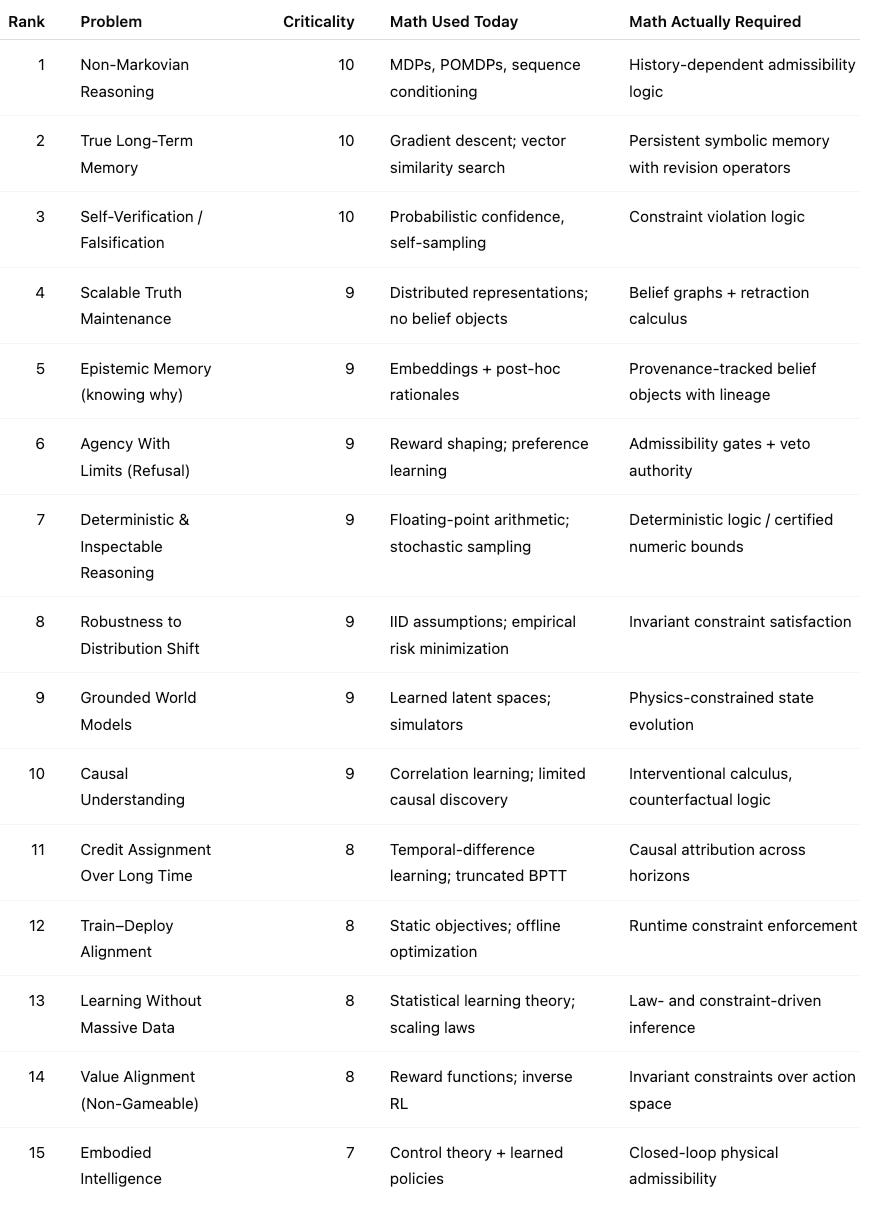
Read the two “Math” columns vertically. On the left: optimization, approximation, probability, gradient descent. On the right: logic, constraints, provenance, determinism, causation.
These are not two points on the same continuum. They are different categories of mathematics. The field is using the left column to solve problems that require the right column. That is why they remain unsolved.
3. The Hype Gap: What the Field Talks About vs. What Actually Matters
Note: By the way we see it
Importance alone does not explain why these problems remain unsolved. Attention matters. Funding follows attention. And attention in AI is systematically misallocated.
The following matrix measures each problem on two axes: Importance (deployment criticality, as above) and Hype (research attention, funding volume, media coverage, conference presence) on a 1–10 scale. The gap between the two reveals where the field is structurally blind.
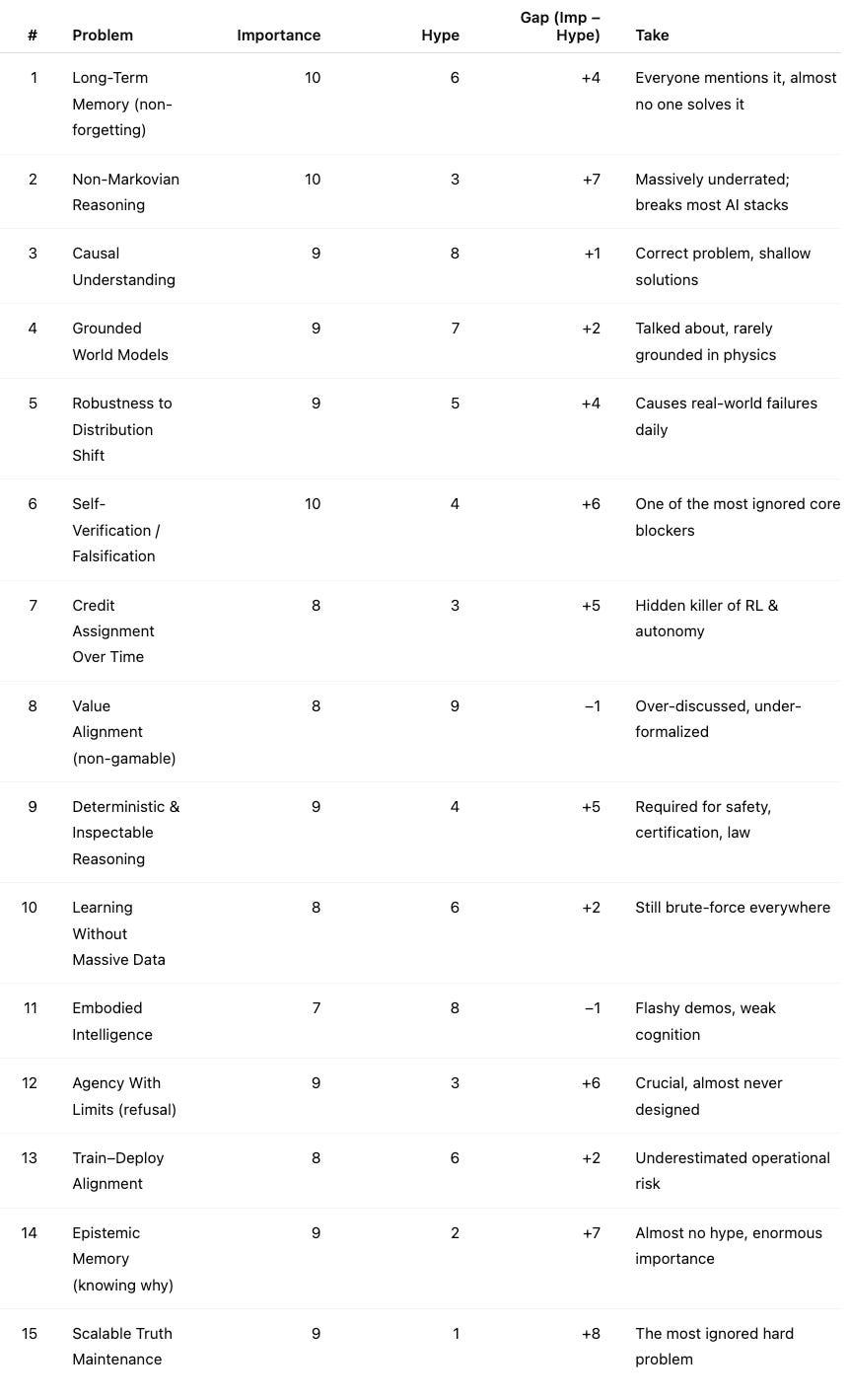
Sorted by gap, a brutal pattern emerges.
Most Important and Most Ignored
These are the real walls that scaling will hit. They have the highest importance and the lowest attention:
Scalable Truth Maintenance (gap: +8)
Non-Markovian Reasoning (gap: +7)
Epistemic Memory (gap: +7)
Self-Verification / Falsification (gap: +6)
Agency With Limits (gap: +6)
These five problems cannot be solved by bigger models, more data, or better prompts. They require different mathematics entirely. And almost no one is working on them.
Correctly Identified but Poorly Solved
These problems are felt as real pain points, but existing architectures do not address them structurally:
True Long-Term Memory (gap: +4)
Robustness to Distribution Shift (gap: +4)
Deterministic & Inspectable Reasoning (gap: +5)
Credit Assignment Over Long Time (gap: +5)
The field acknowledges these. It has not solved them, because solutions require stepping outside the learning paradigm.
Overhyped Relative to Progress
These receive disproportionate attention relative to the structural progress being made:
Value Alignment (gap: −1) — enormous discussion, minimal formalization
Embodied Intelligence (gap: −1) — flashy demos, weak cognitive foundations
Causal Understanding (gap: +1) — correct problem, mostly shallow solutions
High talk-to-substance ratio. Funding flows here because the problems are legible to non-technical audiences, not because the approaches are working.
The Meta-Ranking
If you remembered only three problems that will decide the future of AI systems:
Memory · Falsification · Non-Markovian Authority
Everything else is downstream.
What the Hype Gap Means for Capital Allocation
The gap column is, in effect, a map of mispriced risk and mispriced opportunity. Problems with large positive gaps are simultaneously the most important for deployment and the least funded. This is the definition of a market inefficiency.
Every dollar currently flowing into AI is concentrated in the bottom half of this table — the problems with low gaps or negative gaps. The top half, where the deployment-blocking problems live, receives almost nothing. This is not because the top-half problems are obscure or theoretical. It is because they do not fit the dominant paradigm, and the dominant paradigm controls the funding.
The investors who understand this table are looking at the most underpriced opportunity in AI.
4. Why Learning Cannot Become Intelligence by Scaling
The intuition behind scaling is simple: if a system learns enough patterns from enough data, it will eventually learn to reason, verify, refuse, and maintain beliefs. This intuition needs to be revisited and the mathematics shows why.
4.1 Learning Optimizes. Intelligence Constrains.
Every learning system in AI today minimizes some variant of:
min_θ E[L]
This is optimization over expected loss. It finds the parameters that produce the best average output across a distribution.
Intelligence, for every problem in the top tier of the table above, requires something categorically different:
∀a ∈ A: g_i(a, h_t) ≤ 0 — or refuse.
This is constraint satisfaction with hard admissibility. Not “what output is most likely,” but “what actions are permissible given everything that has happened, and what must be refused regardless of how probable it appears.”
Optimization and constraint satisfaction are not the same operation. You cannot scale an optimizer into a constraint enforcer. They have different mathematical properties, different failure modes, and different guarantees.
4.2 The Specific Large Gaps
Non-Markovian Reasoning: Learning systems assume P(s_{t+1} | s_t, a_t) — the current state is sufficient. Reality requires that the full history of states and actions structurally constrains what is possible next: A_adm(h_t) ≠ A_adm(s_t). A longer context window gives visibility into history. It does not give history the power to veto. History in a learning system is input. In an intelligent system, history is law.
Long-Term Memory: Learning updates parameters: θ_{t+1} = θ_t − η∇_θ L. This overwrites. Old knowledge is destroyed unless artificially protected. Retrieval systems search by similarity — that is lookup, not memory. True memory requires persistence, consistency maintenance, contradiction detection, and revision without corruption.
Self-Falsification: Learning produces: ŷ = argmax P(y|x). Confidence is probabilistic. Self-critique, in a learning system, is just another output sampled from the same distribution — it has no more formal authority than the answer it critiques. Falsification requires a hard operator: ∃ g_i(x) > 0 ⇒ REFUSE. That is constraint violation, not low probability.
Truth Maintenance: In learning systems, beliefs are distributed across billions of parameters, entangled with context and activations. There is no way to retract a single belief without perturbing others unpredictably. Truth maintenance requires explicit structure: B = {b_1, b_2, …}, D(b_i) = {b_j : b_j depends on b_i}, with revision: ¬b_i ⇒ ∀b_j ∈ D(b_i): retract(b_j). This is graph logic.
Epistemic Memory: Learning systems can state facts. They cannot certify why those facts are believed, under what assumptions they hold, or when they expire. Post-hoc explanation generation is rationalization, not provenance. Once reasoning is collapsed into weights, lineage is lost permanently.
Refusal: If refusal is learned — through RLHF, reward shaping, or preference tuning — it is a tendency, not an invariant. Every jailbreak proves this. A probabilistic boundary is a gradient, not a wall. Real refusal requires architectural separation: gates that sit outside the learning process entirely.
Determinism: Learning systems run on floating-point arithmetic with stochastic sampling and nondeterministic GPU kernels. Same input ≠ same output. This alone disqualifies them from medical certification, legal accountability, and safety-critical control. Determinism is not an impractical ideal. It is a regulatory and legal requirement for every high-stakes market AI wants to enter.
5. The Pattern the Field Refuses to See
The contrast below is not metaphorical. It is a difference in mathematical class.
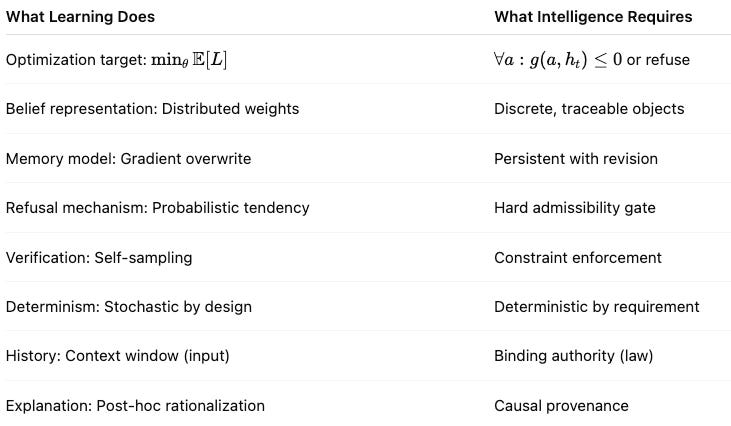
Learning systems are excellent pattern matchers and terrible reasoners about their own knowledge. They can estimate likelihood, similarity, and plausibility. They cannot enforce truth retraction, historical veto, non-negotiable refusal, or deterministic accountability.
This is not a gap that closes with scale. It is a category error. The algebra of optimization is not the algebra of governance. No amount of gradient descent produces constraint satisfaction as an emergent property.
6. Why the Incentive Structure Keeps the Field Stuck
The AI ecosystem rewards learning. It funds learning. It benchmarks learning. It celebrates learning.
What gets funded: Bigger models, better benchmarks, faster inference, broader generality, more impressive demos.
What doesn’t get funded: Epistemic reasoning infrastructure, causal inference engines, decision physics, deterministic computation, formal belief management.
Why: Learning improvements are easy to demo and easy to benchmark. Intelligence infrastructure — the kind that makes systems trustworthy, certifiable, and accountable — is invisible until deployment fails. It is insurance, not spectacle. Markets systematically undervalue insurance until after the catastrophe.
There is also a deeper structural reason: the field’s identity is built on learning. The dominant paradigm, the major conferences, the hiring pipelines, the compute investments, the entire research culture is organized around the assumption that learning, at sufficient scale, becomes intelligence. Questioning that assumption is not just a technical claim. It is a challenge to the organizing principle of the field.
But the evidence in this internal paper is clear. The top fifteen unsolved problems — the ones that determine whether AI can be deployed in the real world — are not learning problems. The field is solving the wrong problems with the incorrect class of physics and mathematics, and it will continue to do so until the learning-intelligence conflation is broken.
7. What Intelligence Actually Looks Like: A New Class of System
The answer is not to add guardrails to learning systems. It is not to wrap LLMs in symbolic constraints. It is not hybrid architectures that bolt governance onto an ungovernable substrate; such systems produce two conflicting authorities, not one coherent intelligence. Patching probabilistic generation with deterministic overrides produces fragile, incoherent systems with failure modes worse than either alone.
The answer is a fundamentally new class of system — designed from first principles around the properties that the top problems actually require.
Decision Physics
Real-world decisions obey laws. Actions have irreversible costs. States have non-negotiable constraints. Time moves in one direction. Resources are finite. Consequences propagate through causal chains, not token sequences.
A system built on decision physics does not need guardrails because the physics is the guardrail. Inadmissible actions do not exist in the action space. They are not generated and then filtered. They are never proposed. The laws of the domain — irreversibility, resource conservation, obligation, precedent — are the axioms of the system, not afterthoughts.
Non-Markovian by Design
Current systems treat history as input. An intelligent system is constituted by its history. Past violations, accumulated obligations, irreversible commitments, and path-dependent constraints are not stored in a context window to be attended to. They are part of the state representation itself. The architecture makes it structurally impossible to act as if history did not happen.
This is the difference between a system that can read a patient’s medical history and a system where that history permanently constrains what treatments are admissible. The first is a learning system. The second is an intelligent one.
Epistemic Intelligence
Every belief has provenance. Every inference has a derivation chain. Every conclusion has explicit assumptions, and when an assumption fails, everything downstream is automatically identified and flagged. The system cannot hold a belief without knowing why it holds it.
This is not “explainable AI” — a post-hoc narrative for a compliance checkbox. This is a system where the epistemic structure is the reasoning. Transparency is not a feature. It is the architecture.
Causal Intelligence
The system reasons natively in terms of interventions and counterfactuals. Not “what patterns co-occur” but “what happens if I do X” and “what would have happened if I had done Y instead.” Causal models are a primitive, not an optional module. When causal structure is uncertain, the system knows that — and its uncertainty is structured, not just a softmax temperature.
Deterministic by Design
A deterministic system produces the same output for the same input, every time. Its reasoning can be replayed, audited, certified, and held legally accountable — not metaphorically, but in court.
This is the most radical departure from current practice, and the most necessary. Every regulated market — healthcare, finance, legal, defense, infrastructure — requires it. No stochastic system can provide it. The field treats determinism as impractical. The markets that matter treat it as mandatory.
8. The Opportunity — For Researchers and Investors
For Researchers
The top unsolved problems in AI are not neural scaling problems. They are not transformer problems. They are not even machine learning problems in the conventional sense. They are problems of decision physics, epistemic architecture, causal reasoning, and deterministic computation.
The mathematical foundations exist — in constraint satisfaction, in truth maintenance systems, in causal calculus, in formal verification, in non-Markovian decision theory. What does not exist is the integrated system that brings them together as a coherent, deployable intelligence architecture.
This is a foundational research opportunity of the first order. Not an incremental advance on existing paradigms, but the opening of a new one. The researchers who pursue it are not competing with scaling labs. They are working on the next problem — the one that learning, by mathematical necessity, cannot reach.
For Investors
The AI market has a massive, mature learning layer — and an effectively unbuilt intelligence layer. This is not because intelligence is unimportant. It is because the prevailing assumption — that learning becomes intelligence at scale — has prevented anyone from building intelligence natively.
That assumption is mot accurate. The problems documented in this document prove it is a real challenge to be addressed. And when the market corrects, the correction will not be incremental. It will be architectural.
The hype-gap matrix in Section 3 is, in effect, a map of mispriced opportunity. The five most deployment-critical problems in AI — scalable truth maintenance, non-Markovian reasoning, epistemic memory, self-falsification, and architectural refusal — have a combined hype score of 13 out of a possible 50. They are the most important and the least funded problems in the field. This is the definition of a structural market inefficiency.
The opportunity is not “better guardrails for learning systems.” It is a new class of AI — non-Markovian, epistemically structured, causally grounded, and deterministic by design. Systems that can be certified, audited, and held legally accountable. Systems that can operate in the markets where the stakes are highest and the regulatory requirements are strictest — precisely the markets that current AI cannot enter.
Where first-mover value concentrates:
Decision physics engines — systems where irreversibility, admissibility, and consequence are architectural primitives, not external filters. An entirely new product category.
Epistemic reasoning infrastructure — native provenance, dependency-aware belief management, automatic invalidation propagation. Not explainable AI. Intrinsically transparent intelligence.
Causal inference platforms — systems that reason about interventions and counterfactuals as a core capability, for medicine, policy, finance, and operations where “what if” is the fundamental question.
Deterministic AI for regulated industries — certifiable, repeatable, auditable decision systems for healthcare, finance, legal, defense, and critical infrastructure. These markets have explicit requirements that no learning system can meet. The regulatory barrier is the moat.
Non-Markovian state architectures — systems where history is constitutive, not contextual. Foundational for any domain where accumulated risk, legal obligation, or irreversible commitment matters.
The timing: The learning era has peaked in architecture, if not in scale. The intelligence era has not begun. Every major AI deployment failure in the coming years will be an intelligence failure — not a learning failure. The teams that build natively intelligent systems — not patched, not wrapped, but designed from first principles — will define the next decade of the field.
This is not a niche within AI. It is the half of AI that has not been built yet.
9. Conclusion
The field built learning and called it intelligence. It is not.
Learning extracts patterns. Intelligence reasons about causes, maintains beliefs with provenance, operates under irreversible constraints, refuses when it must, and accounts for its decisions deterministically.
The fifteen most critical unsolved problems in AI are intelligence problems, not learning problems. The mathematical evidence is unambiguous: optimization over expected loss cannot produce constraint satisfaction, belief revision, causal reasoning, or deterministic accountability as emergent properties. These require different mathematics, different architectures, and different first principles.
The hype-gap analysis confirms what the mathematics predicts: the problems with the highest importance and the lowest attention are precisely the ones that require a departure from the learning paradigm. The field’s attention is inversely correlated with what matters most.
The systems that solve these problems will not be larger versions of what exists today. They will be a new class of AI — built on decision physics, non-Markovian reasoning, epistemic intelligence, causal inference, and deterministic design.
The researchers who build them will not just improve the current era of AI. They will redefine the current cycle and begin the next one. That will truly ignite applications like Physical AI the world has never seen in the last 100 years and create impact on society on a planetary scale.
Copyright © 2026 Gerard Rego
*This is personal research and documentation and is provided for research, ideas and evaluation purposes only. My personal views only.
All Rights Reserved. All data, organizations and other links are copyright of their respective owners. As part of this entire manuscript and all associated materials are protected by copyright, trademarks and patent applications pending. No part of this work may be reproduced, distributed, or used commercially without written permission. Commercial use prohibited without permission. No part of this work may be reproduced, distributed, or used to create derivative works without prior written permission of the author, except as permitted under applicable fair-use provisions for scholarly citation, review, or critique with proper attribution. This is personal research and documentation and is provided for research, ideas and evaluation purposes only