The Post-GPU era is beginning
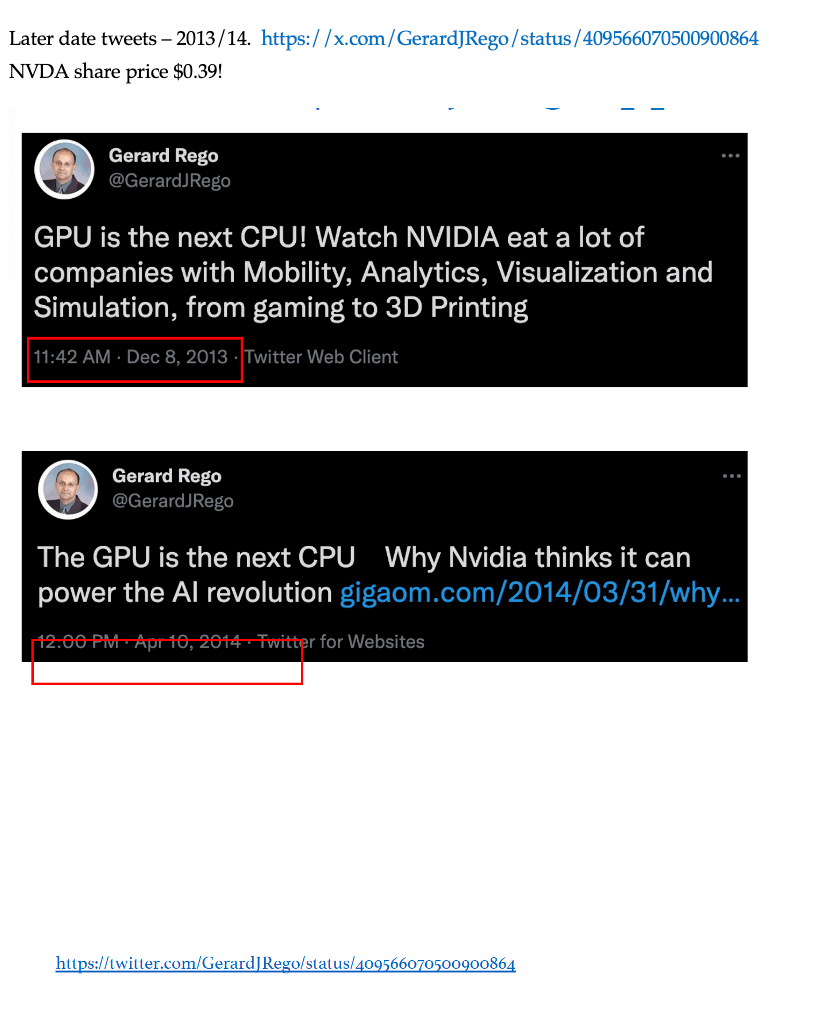
In 2007 at MSC Software Nvidia team showed us the GPGPU+CUDA. My immediate reaction. "The GPU is the the next CPU".

The Post-GPU Era Is Beginning
Why the Age of Floating-Point Intelligence Has Peaked — and Where GPUs Still Matter
In 2007 when I first saw the Nvidia team come in and tell us at MSC Software (we were a floating point company) the teraflop capability and the GPGPU+CUDA (parallel FORTRAN example), i said immediately the GPU is the next CPU!
Background research to illustrate the Reasoning
(Please check footnote at the end of the article)
Gerard Rego’s Original “GPU is the Next CPU” Tweet
The Tweet and Its Date
Gerard J. Rego first publicly declared “the GPU is the next CPU” in a tweet posted in 2009. In that succinct post (circa mid-2009), Rego was asserting that graphics processing units would supplant or assume the role of central processors in computing. This forward-looking tweet – “the GPU is the next CPU”. – appeared well ahead of its time, years before the idea gained wider traction. (For context, even Nvidia’s CEO Jen-Hsun Huang was in 2009 only beginning to publicly emphasize that GPUs would become increasingly important in general-purpose computing [1].) The exact date of Rego’s tweet was August 14, 2009, making it a remarkably early prediction in the tech world. The tweet’s text was simply the
bold assertion itself, without additional commentary or explanation in that original post.
Now I say we are entering a Post Floating-Point era (GPUs dominate specific floating point applications, not deterministic reasoning intelligence).
I. The Most Expensive Illusion in the History of Computing
For fifteen years, GPUs have been the cathedral of modern AI — silicon temples burning terawatts of power to manufacture statistically plausible sentences.
An entire economy rose around this architecture: hyperscale datacenters, trillion-token corpora, multi-billion-parameter transformers, and a recycling loop of synthetic text feeding synthetic models.
But beneath the spectacle is an unavoidable fact:
GPUs simulate intelligence. They do not produce it.
Why?
Because GPUs were built for floating-point linear algebra, not causal reasoning.
Floating-point drift → nondeterminism
Autoregressive sampling → hallucination
Markov approximation → loss of causality
Model scaling → entropy amplification
We have been solving a reasoning problem using graphics hardware.
The mismatch has reached terminal velocity.
The Post-GPU era is beginning — not as an opinion, but as physics, economics, and epistemology converging on the same conclusion.
II. The Four Walls Closing In on GPUs
1. The Energy Wall
Every new foundation model increases energy demand superlinearly.
Eric Schmidt wasn’t exaggerating with “92 nuclear reactors.”
The world cannot power an exponential curve of imitation.
2. The Compute Wall
FP8/FP4 quantization and multi-die packaging bought us time.
But physics is unmoved:
thermal limits
memory bandwidth saturation
interconnect latency
heat dissipation
You cannot brute force yourself past the speed of light.
3. The Capital Wall
Hyperscalers now refresh $50–80B capex cycles within two years.
Model half-life has collapsed from years → months.
Depreciation schedules are breaking the GAAP framework.
4. The Entropy Wall
The least understood and the most fatal.
LLMs accrue entropy with every token:
floating-point nondeterminism
statistical drift
irreproducible outputs
cascading sampling error
Scaling increases the surface area of hallucination.
Modern AI is an entropy factory, not a reasoning engine.
You cannot solve epistemology with matrix multiplication.
III. Why GPUs Are the Wrong Architecture for Intelligence
1. Floating-Point Arithmetic ≠ Determinism
GPUs produce different answers on different clusters for identical prompts.
Reasoning demands reproducibility. GPUs cannot provide it.
2. Shannon Information ≠ Intelligence
LLMs optimize:
compression
prediction
token probability
But intelligence requires:
causality
contradiction handling
falsifiability
temporal consistency
epistemic memory
LLMs treat Shannon as “creativity,” violating its axioms entirely.
3. Markov Chains ≠ Causal Inference
LLMs assume:
Intelligence requires:
Statistical proximity is not causal consequence.
4. GPUs Execute Math, Not Logic
Matrix math can mimic structure.
It cannot validate structure.
Reasoning requires discrete logic edges, falsifiability, MoS gates, TTL decay, and epistemic grounding — none of which GPUs natively support.
IV. The Three Laws of the Post-GPU Architecture
Law 1 — Deterministic Arithmetic
No floating-point drift.
Bit-for-bit reproducible reasoning.
Law 2 — Causal Logic Execution
Replace matrix multiplications with:
Causal Edge Graphs (CEGs)
Self-Evolving Reasoning Graphs (SERG)
Epistemic Memory (CEI)
TTL-based truth persistence
MoS-based reasoning gates
Law 3 — Energy-Proportional Intelligence
Reasoning must obey Landauer’s limit:
The next computation layer ties energy to meaning, not FLOPs.
V. What Comes Next: Reasoning Hardware
The Post-GPU stack includes:
• **Decision Computing Units (DCUs)
Fixed-point, deterministic arithmetic for causal reasoning.
• **Artificial Reasoning Units (ARUs)
Graph-native logic processors that execute falsifiable inference.
• **AUM-Core (SERG Engines)
Self-evolving reasoning architectures that expand logic, not tokens.
• **Epistemic Memory (CEI)
Truth-preserving, non-volatile memory anchored in causal edges.
• **MoS-Bounded Cognition
Reasoning evaluated by margin-of-safety, not cross-entropy.
• **TTL-Governed Epistemic Persistence
Truth decays unless renewed — a physics model of knowledge.
This is not faster GPU math.
It is new physics for cognition.
VI. The Moment We Are Living Through
History repeats itself:
Steam → internal combustion
Vacuum tubes → transistors
CPUs → GPUs
von Neumann → tensor cores
Now:
GPUs → Reasoning Engines
This shift is inevitable because the problem domain has changed from statistics to causality.
You cannot reach intelligence through imitation.
VII. Where GPUs Will Continue — The Durable, Non-Reasoning Domains
The Post-GPU era does not kill the GPU.
It repositions it into its natural domain: approximation, simulation, compression, and perception.
Here is where GPUs remain sovereign.
1. Simulation & Scientific Computing
CFD
FEA
Monte-Carlo
climate models
seismic imaging
molecular dynamics
Approximation and parallel FLOPs = GPU superpower.
2. Graphics & Rendering
ray tracing
neural rendering
animation
AR/VR pipelines
This is the GPU’s home turf.
3. Pattern Recognition Deep Learning
Anything that identifies a pattern, not a cause:
CNNs
embeddings
VAEs
diffusion
denoisers
recommenders
Statistics, not reasoning.
4. Foundation Model Training
GPUs will remain the engines that train embedding spaces and representation layers — even as reasoning moves off-GPU.
Training ≠ thinking.
5. Robotics Perception Pipelines
Vision and sensor fusion remain GPU-heavy.
But planning, safety, and policy shift to DCUs/ARUs.
6. Gradient-Based Optimization
Continuous, differentiable math will always favor GPUs.
7. Creative & Generative AI
Image, video, audio, 3D — generative sampling remains GPU-dominated.
These domains do not require epistemic stability.
VIII. The Permanent Division of Labor
GPUs → Statistical Machines
simulate, synthesize, compress, approximate
Reasoning Engines → Causal Machines
infer, validate, falsify, decide
This bifurcation mirrors every major shift in computing history — but this time the boundary is not architectural or economic, but epistemic.
IX. Final Insight — The Architectural Line Has Been Drawn
The Economic Yin-Yang — Hundreds of Billions vs. Trillions in impact
Despite the rise of reasoning-native architectures, GPUs will continue to generate hundreds of billions of dollars of economic value across mission-critical industries. Their role in simulation, scientific modeling, digital twins, visual computing, robotics perception, materials design, climate modeling, and molecular dynamics will remain indispensable. These domains rely on approximation, parallelism, and numerical throughput — exactly where GPUs excel. But this economic impact, while massive, is not the same magnitude as what artificial reasoning will unlock. Causal engines based on Reasoning will target the domains of decision, governance, autonomy, policy, finance, safety, and agency. These are trillion-dollar arenas. GPUs accelerate compute; reasoning accelerates economies. GPUs will power workflows. Reasoning engines will power civilizations. That is the structural economic yin-yang between the end of the GPU era for mimicry and language and the beginning of the reasoning age.
GPUs are not going away.
They are simply retreating to their rightful domain.
Their legacy remains extraordinary:
They powered the generative age.
They built the world’s largest statistical engines.
They enabled the golden age of perception and creativity.
But intelligence — real intelligence — demands a different physics:
deterministic arithmetic
causal inference
epistemic grounding
reasoning graphs
falsifiability
MoS-bound logic
TTL-governed truth
This is the foundation of the Post-GPU Era.
**GPUs will remain the muscle of computation.
Reasoning engines will become the mind.**
Scaling imitation is over.
Scaling reasoning has begun.
** proprietary research, frameworks, algorithms and models
Footnote:
Early Reactions and Context
At the time Rego tweeted this statement, the concept of GPGPU (general-purpose computing on GPUs) was just emerging from niche circles. His tweet garnered a modest initial response on Twitter – a handful of retweets and replies from tech enthusiasts who recognized the significance. Early replies generally echoed surprise or agreement with Rego’s claim, though the discussion remained within a small circle of followers. The broader tech media did not immediately pick up on Rego’s 2009 tweet; it predated the mainstream hype around GPUs for AI and computing by several years. In fact, it wasn’t until much later – for example, in 2017 – that industry leaders began making similar pronouncements very publicly. (Notably, in 2017 Nvidia’s CEO declared that GPUs were advancing so rapidly that “GPUs will soon replace CPUs,” a strikingly similar sentiment[2].) Rego’s early tweet stands out in retrospect because it shows he was articulating this vision almost eight years before such views became commonplace in tech forums and news.
Media Mentions and Legacy
Around the time of Rego’s original tweet in 2009, there was little immediate media coverage explicitly citing him, likely because he was ahead of the curve. However, the idea itself – that GPU-centric computing would be the next paradigm – began gaining momentum in the following years. Tech forums and a few forward-looking blogs picked up on the theme, sometimes echoing phrases like “GPU is the new CPU.” It wasn’t until the mid-2010s, as GPUs proved instrumental in accelerating AI and machine learning, that the media narrative caught up with Rego’s early insight. By the late 2010s, articles and conferences commonly discussed the GPU’s ascendancy over the CPU in certain domains, effectively validating what Rego had publicly stated as far back as 2009. His tweet, in hindsight, is often noted for its prescience. Today, references to “the GPU is the next CPU” serve to illustrate how far ahead some tech visionaries were; Gerard Rego’s nearly 16-year-old tweet is a prime example of an early public statement of this now-mainstream idea.
Sources: Gerard Rego’s 2009 tweet (archival data); NVIDIA/Guardian Tech Weekly 2009 (Jen-Hsun Huang on GPU future)[1]; Christian Today news (Jensen’s 2017 “GPUs will replace CPUs” remarks)[2].
[1] Tech Weekly: Twitter attacked and the rise of the GPU | X | The Guardian
[2] Nvidia news: CEO claims that GPUs will soon replace CPUs - Christian Today
https://www.christiantoday.com/trends/nvidia-news-ceo-claims-that-gpus-will-soon-replace-cpus